


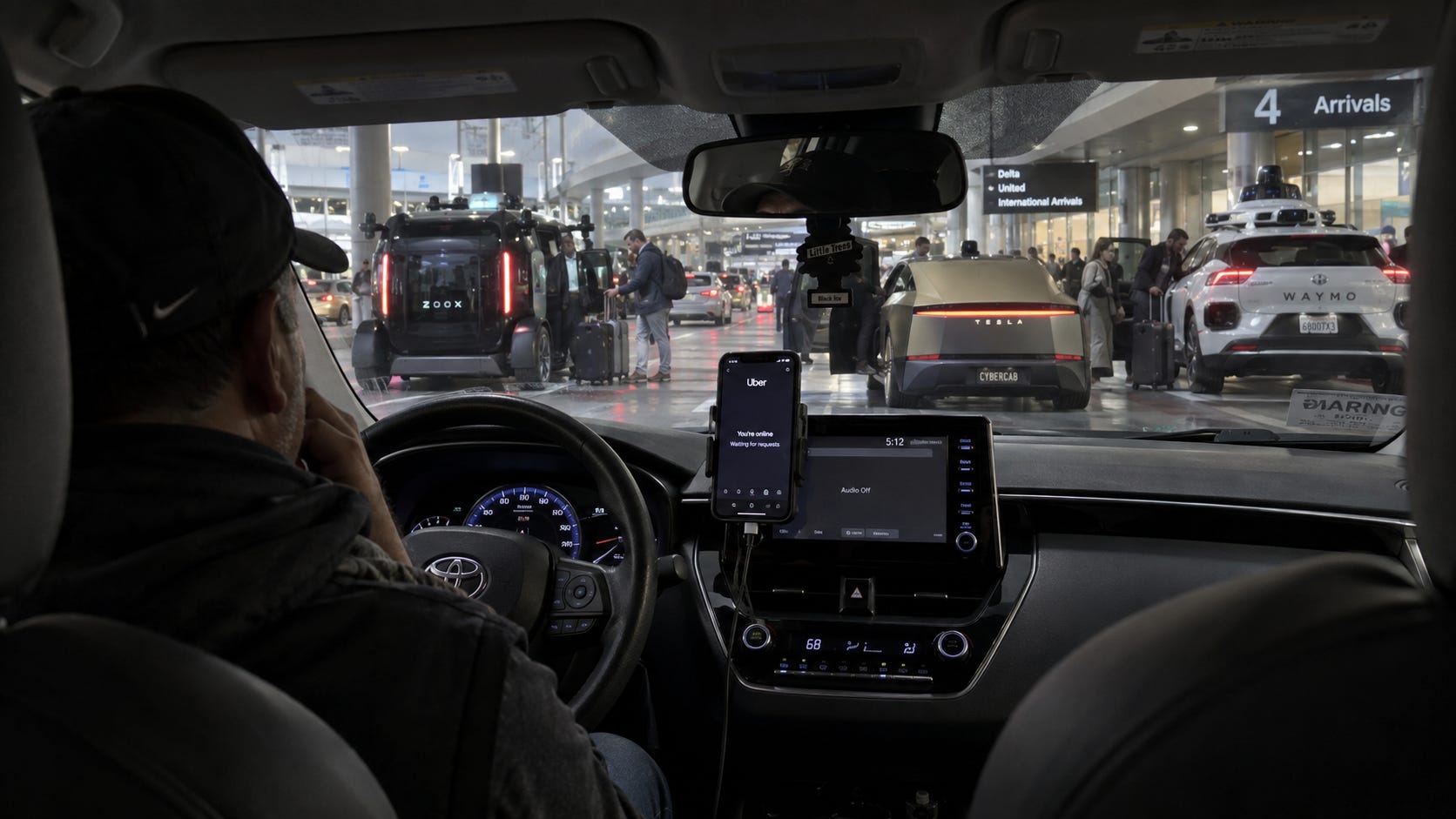
It is rush hour, and you waltzed onto the airport arrivals curb at the Harry Reid International Airport; right in front of you a zoox pod idles a few car lengths from a Tesla Cybercab, a driverless Waymo pulls in behind them, hazards blinking to announce it’s arrival and readiness to commence the trip. In the middle of that lineup sits a sedan with a human behind the wheel waiting on his Uber app to accept a request.
That is not a rendering, it is the new reality.
Edgar Briseno has spent most of his years working that same corridor, more than 50,000 rides logged between Uber and Lyft. He won’t tie his falling income directly to the robotaxis now sharing his curb, zoox started serving the airport this year, Waymo struck partnerships with the Raiders and The Venetian, but he’s watching closely, because he has a family to support. “I sometimes take rides, I know they’re not profitable for me but I have family and kids,” he said. “I have to keep providing for them.” He put the bigger picture more plainly still:
“I know the future is here with the new technology, but they have to think also about the humans.”
The scale behind that worry is real. Waymo now runs paid, fully driverless rides in 14 US cities, over 500,000 trips a week, more than 20 million rides total by May, aiming for a million a week by year end. Uber, the company built by human drivers, is now the industry’s biggest matchmaker for the machines replacing them, partnered with Waymo, Nuro, Wayve, Baidu, and others. Gridwise Analytics, which tracks driver earnings, found drivers in the five US metros with robotaxis completed 5.3 percent fewer trips per hour in late 2025 than the year before, roughly double the national decline.
But this isn’t a clean story of jobs vanishing overnight. Lyft’s own statement on the matter argues drivers “will always be essential to the rideshare community,” pointing to help with luggage, assisting riders who need it, local knowledge, human interaction, the parts of the job a robotaxi cannot do.
Lyft’s CEO has gone further, calling the odds of full replacement in any near term close to zero. Uber, watching Waymo eat its market share, has quietly started allying with driver unions to push legislation requiring a minimum number of human drivers alongside the robots. And 350,000 California Uber and Lyft drivers just won the right to unionize, a 12 year fight arriving at the exact moment that leverage is being tested.
The more interesting shift might be what driving becomes rather than who does it.
London is piloting robotaxis with a human still in the seat, ready to take control in an emergency, and researchers warn that watching a machine drive doesn’t keep the same skills sharp as driving does yourself. Human in the loop only works if the human stays actively in it, not just present.
Some drivers are moving sideways instead of out. Autonomous Vehicle (AV) companies are actively hiring safety drivers and data collection drivers, built for people with exactly Briseno’s kind of experience, paying in the same range as rideshare work. The job shifts from finding the fastest route to knowing exactly when to take the wheel back.
Briseno is still out there working that curb, still taking rides he knows won’t pencil out, because providing for his family doesn’t pause for a technology cycle. If there’s a lesson in that for anyone outside a car right now, it’s this: the job that survives automation is rarely the exact job you had. It’s the version of it that stays alert, useful, and present in the ways the machine still can’t be.
This is not a financial or career advice, however, if you’re a driver weighing your own next move, connect with like-minds who are actually living the transition in your city before making any big decisions.