



In 2023, a copywriter was one of sixty people on a professional writing team. By 2024, he was the last human standing, brought in not to write, but to clean up AI-generated content. A few months later, even that job disappeared. His final act in the industry? Landing at a firm that makes AI writing harder to detect.
If there is a more sobering summary of what is happening to content writers right now, I haven’t found it.
But here is what I’ve also found: the story doesn’t end there. And the writers who understand exactly what is happening, not the exaggerated version, not the dismissive version, but the data-backed, eyes-open version, are positioning themselves to build careers that AI cannot replicate.
This is Episode 1 of Adapt or Die! A WIIFM’s series on AI and the professions it is reshaping. We’re starting here because no profession has felt the disruption as fast, personally, or financially as content writers and copywriters. Let’s get into it.
The Numbers Don’t Lie, they’re very uncomfortable too.
Let’s not bury the lead.
An analysis of 180 million real job postings, published by Bloomberry in March 2026, found that writer roles, copywriters, copy editors, and technical writers declined by 28% over just two years. Journalists and reporters dropped 22%. PR specialists fell 21%. These are not projections. These are seats that have already disappeared from the market.
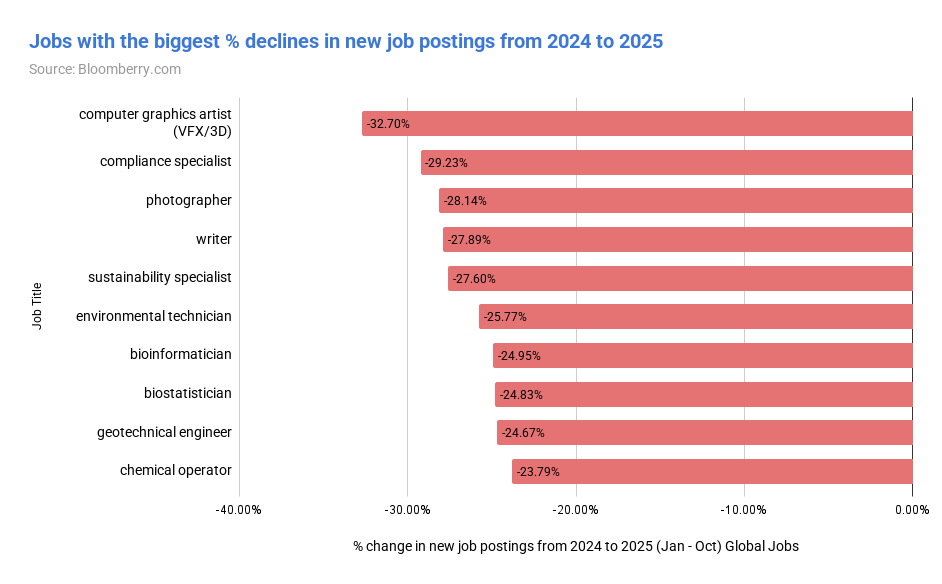
And the timeline tells you everything. The drop from 2022 to 2023 was described by workers in the field as “bad.” The drop from 2023 to 2024? “Catastrophic.” By 2025, markets that historically picked up in spring showed “hardly a pulse,” in the words of one freelancer who had run a copywriting business for over a decade.
On the supply side, the numbers are just as stark. HubSpot’s AI Trends for Marketers report tracked marketing’s AI adoption jumping from 21% in 2022 to 74% in 2023, a 53-point leap in twelve months. By 2025, that figure had climbed to 78% across the US. Siege Media found that 83.2% of content marketers planned to use AI content-generation tools in 2024. A separate study found that 94.5% of content creators worldwide were already using AI for editing, image generation, or writing captions. And 47% were already using it to generate content.
The math is simple. Demand for human writers collapsed at the same rate that the supply of AI-written content exploded.
Goldman Sachs, in its landmark report on AI and labour, estimated that 300 million full-time jobs globally are exposed to AI automation, with roughly 25% of all US work hours potentially automatable. Bloomberg research cited by FinalRoundAI adds a sharp number specific to writers: 53% of market research analyst tasks and 67% of sales representative tasks are job functions that lean heavily on written communication, and are now automatable.
The World Economic Forum’s Future of Jobs Report 2025, the most comprehensive survey of its kind (1,000+ companies, 14 million workers, 55 economies), projects that 92 million jobs will be displaced by 2030 due to AI and automation. Content roles are directly in the crosshairs.
What Is Actually Happening on the Ground
The data has a human face. It helps to look at it.
Entire writing teams are being replaced overnight.
The case of the 60-person copywriting team isn’t unique; it’s archetypal. Companies discovered that AI could produce first drafts of product descriptions, social captions, email sequences, and marketing blog posts at a fraction of the cost. Some didn’t even tell their writers what was coming.
Major companies are restructuring around AI writing tools.
Grammarly, a company whose entire value proposition rested on human writing quality, laid off approximately 230 employees in February 2024 as it refocused on AI-enabled productivity.
Microsoft’s 2025 layoffs, spanning multiple rounds and affecting over 15,000 employees, hit programmers, program managers, and knowledge workers hardest, as the company’s CEO publicly stated that AI now writes up to 30% of Microsoft’s code.
The freelance market has been hit particularly hard.
Entry-level and junior writers are most exposed to product descriptions, social media captions, and basic blog posts, which can now be automated cheaply and at scale. A peer-reviewed study by researchers at Imperial College Business School, Harvard Business School, and the German Institute for Economic Research found that within just eight months of ChatGPT's launch, demand for freelance writing jobs dropped 30%, the steepest fall of any professional category, outpacing even coding (down 20%) and graphic design (down 17%).
For many writers still in the market, the numbers match the feeling on the ground: fewer briefs, lower rates, and a pipeline that went from slow to almost silent between 2023 and 2025.
81.6% of digital marketers now expect AI to replace content writers. That’s not a fringe view. That’s the mainstream expectation inside the industry.
But Here’s the Twist in the Story
In 2024, a study conducted by Bynder compared AI-generated and human-written content and found that 56% of participants actually preferred the AI version in the test they ran. That headline circulated everywhere and scared a lot of writers.
Here’s what didn’t get circulated: in the same research landscape, 52% of consumers said they disengaged from content they suspected was AI-generated, and 20% said they viewed brands using such content as untrustworthy.
That tension, AI content is technically preferred in A/B tests, but trusted less at the brand relationship level, is the crack in the wall that every smart writer should be walking through.
The question is no longer “Can AI write?” It can. The question is: “Can AI earn trust?” And the data says: not yet, not consistently, not at the level that matters for long-term brand equity.
This is where you come in.

How to Not Just Survive, But Build Something Durable
1. Your Voice Is Your Moat
AI can write. It cannot write as you.
The writers who will thrive in the next decade are the ones who invest relentlessly in a distinct, recognizable voice, one that carries perspective, lived experience, specificity, and a point of view that a language model cannot simulate.
The Bynder research confirms it: consumers are actively looking for evidence of human authorship, and they penalize brands that hide behind AI-generated sameness.
Your voice is not a soft skill. It is your hardest competitive advantage.
2. Niche Down to Where Hallucinations Are Unacceptable
AI writes fast. It also makes things up with confidence. In pharmaceutical, legal, regulated finance, and scientific publishing, a single hallucinated fact can trigger a lawsuit, a regulatory violation, or a retraction. These industries need human writers who understand the subject matter, can verify sources, and will put their name on the work.
Niche expertise, not generalist output, is what protects a writing career in an AI-saturated market.
3. Become the Editor, Strategist, and Director That AI Needs
Here is the paradox of AI content: the more it exists, the more valuable the human who governs its quality becomes. Companies generating thousands of AI-written pages per month still need someone to own the brief, set the tone, catch the errors, maintain brand consistency, and sign off on publication.
That person is now called an AI Content Strategist, an AI Editorial Lead, or a Content Operations Director.
The role didn’t exist five years ago. It’s one of the fastest-growing adjacent positions in content. Learn to write the brief, design the workflow, and manage the machine. The machine cannot manage itself, at least yet.
4. Go Directly to Your Audience
The most resilient writers in 2026 are not the ones submitting pitches to agencies. They’re the ones building newsletters, podcasts, and YouTube channels and monetizing directly from an audience that follows them for who they are, not just what they produce.
If a hundred companies no longer need you, but ten thousand readers do?
Now that is business. Platforms like Substack, Ghost, Beehiiv, Maven, and LinkedIn newsletters have made this path accessible in a way it never was before AI disrupted the commercial writing market.
Build the audience before you need it.
5. Specialize in High-Empathy, High-Stakes Content
AI is extraordinarily bad at grief, or so I think. It is terrible at cultural nuance as well. It has no lived experience of immigration, illness, loss, joy, or the specific texture of belonging to a community. Long-form personal essays, investigative journalism, memoirs, oral histories, and narrative non-fiction remain deeply human territories.
The most durable writing career is one that goes toward complexity, toward people, toward places and experiences that cannot be distilled into a training dataset.
6. Build Hybrid Technical Skills; Don’t Just Write
AI fluency multiplied by writing craft is creating entirely new roles. Prompt engineering, RAG (Retrieval-Augmented Generation) knowledge management, SEO strategy, content operations architecture, and brand-voice systems design are skills that combine with writing to create professionals that the market genuinely does not have enough of.
A writer who can also set up a content AI pipeline, train it on a company’s tone of voice, and audit its outputs for compliance is not competing with AI. They’re commanding it.
7. Work Where Accountability Lives
There is a quiet principle emerging across every industry disrupted by AI: when the stakes are high enough, humans stay in the loop. In legal writing, someone must be responsible for what is filed in court. In medical writing, someone’s clinical judgment validates the content. In executive communications, someone’s reputation is on the line.
Find the writing work where accountability is non-negotiable. Not because AI can’t do it, but because the world has decided that it shouldn’t do it alone.
The Bottom Line
The writing industry is not dying. It is being violently restructured. The writers who will emerge on the other side are not the ones who ignored what was happening, nor the ones who gave up because of it.
They are the ones who looked at the data honestly, moved up the value chain before they had to, built direct relationships with audiences, specialized into territories that AI makes a mess of, and learned to direct machines rather than compete with them.
The algorithm is writing now. The question is: who’s going to decide what it says?
That is still you; if you choose it.
Adapt or Die! is not a threat. It’s an invitation.
The writers who treat it as one will still be here when the dust settles. For the ones who don’t, well, the algorithm already has their job posting.
Disclaimer: The insights in this article are curated from third-party research and publicly available data for informational and advisory purposes only. They are not intended as professional career, legal, or financial advice. All sources are cited. Please verify information independently and seek qualified guidance where appropriate.
About this series: Adapt or Die! is WIIFM’s ongoing series on AI and your career. Each episode picks one profession facing AI disruption, examines the threat honestly with real data, and maps a practical path to staying relevant, valuable, and ahead. No doom-scrolling. No denial. Just what you need to know and exactly what to do about it.