

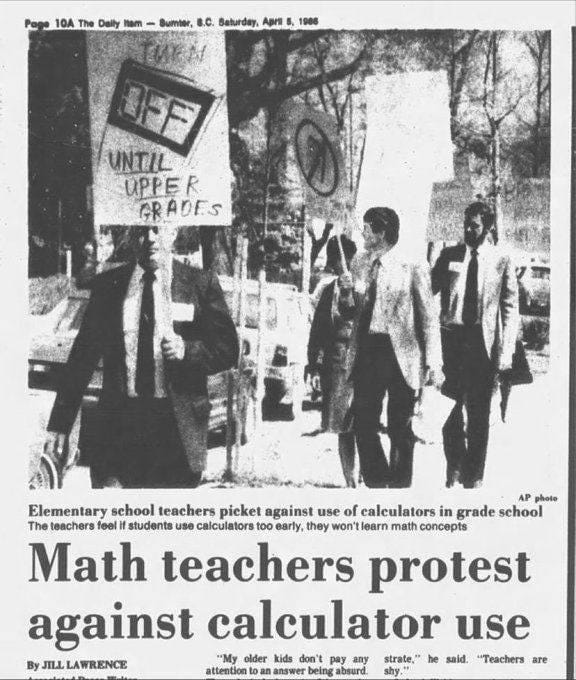
In 1986, some math teachers protested the use of calculators in classrooms.
Their fear was simple: if students used calculators, they would stop thinking.
Looking back now, it sounds almost funny because calculators did not destroy mathematics. They changed how mathematics was taught, tested, and applied. The calculator became a tool. The real advantage still belonged to the person who understood the problem.
And that is exactly where we are with artificial intelligence.
AI is not the enemy.
The enemy is refusing to adapt while expecting the world to slow down for you.
That may sound harsh, but history has not been kind to people who waited for technology to ask for permission.
This has happened before
Every major wave of technology arrives with panic.
When machines entered factories during the Industrial Revolution, many workers feared that machines would permanently remove the need for human labour. Some of that fear was valid. Certain manual jobs disappeared. But new roles emerged around machine operation, maintenance, supervision, logistics, design, safety, and production management.
The people who survived the shift were not always the strongest workers. They were the ones who learned how to work with the machine.
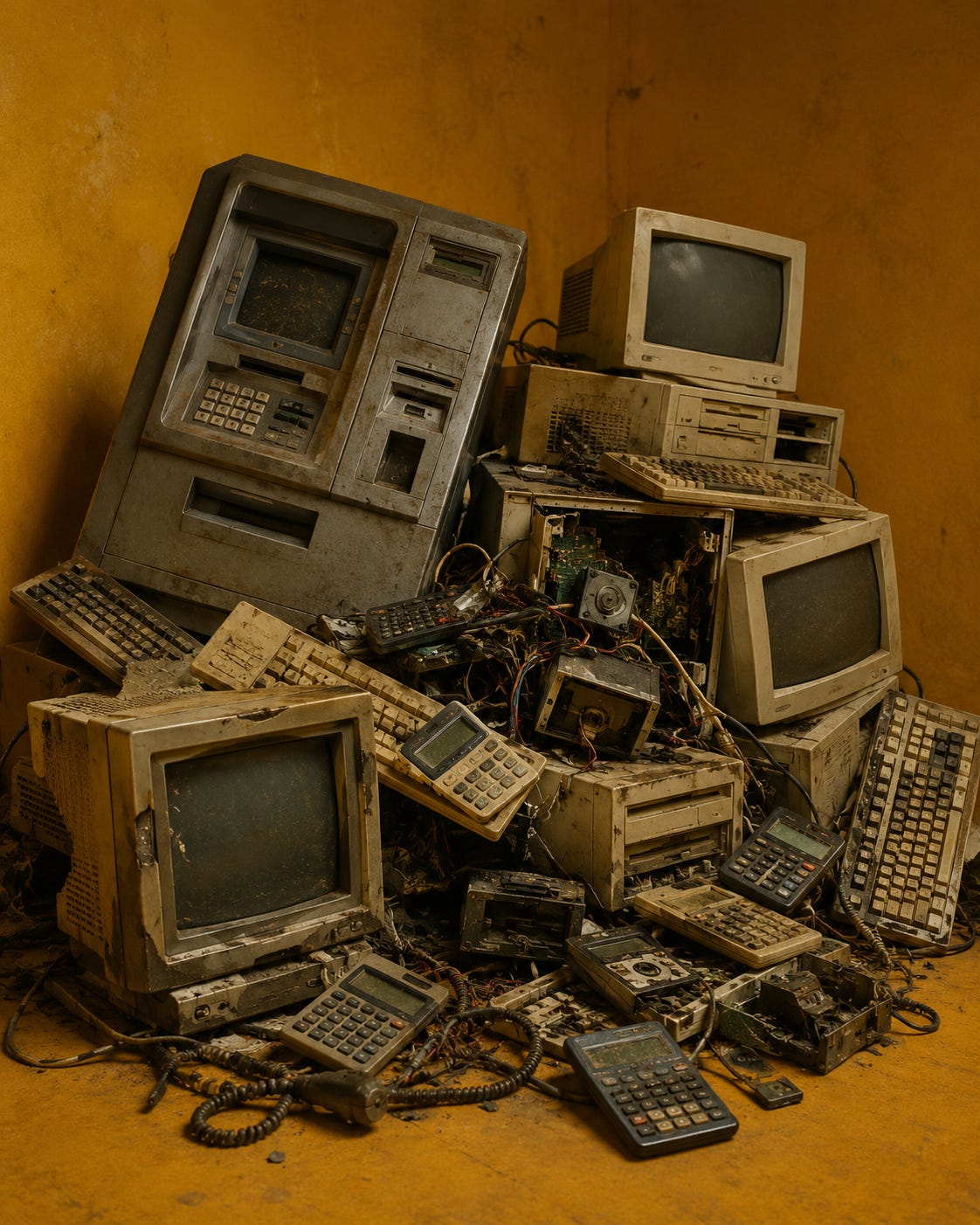
Then came office technology.
Typewriters, photocopiers, computers, spreadsheets, and word processors changed administrative work. A secretary who only typed what was dictated became vulnerable. But an administrative professional who could manage schedules, prepare documents, coordinate meetings, use software, communicate with stakeholders, and keep an office running became more valuable.
The job did not simply disappear. The job description matured.
Then came ATMs.
People expected automated teller machines to wipe out bank tellers. But studies of automation and labour show something more interesting: ATMs reduced routine cash-handling tasks, while banks expanded branches and shifted many staff toward customer service and relationship banking. In other words, the machine took the repetitive part, and humans moved closer to trust, advice, and relationships. (MIT Economics)
Then came calculators in schools.
The fear was that students would become lazy. But calculators eventually became normal educational tools. The bigger question became: Does the student understand the concept, or are they just pressing buttons? That question is still relevant today, except now the calculator writes essays, designs logos, builds apps, analyzes data, and summarizes board reports.
Then came the internet.
People said online stores would kill retail jobs. They did not kill commerce. They changed it. New jobs appeared in digital marketing, logistics, e-commerce management, UX design, customer support, cybersecurity, product management, SEO, content creation, data analytics, and platform operations.
The lesson is painfully consistent:
Technology rarely destroys work completely. It destroys outdated versions of work.
The current wave is different, but not completely new
Yes, AI feels different.
It is not just a machine in a factory. It is not just a calculator in a classroom. It is not just a website replacing a brochure.
AI can write. Code. Summarize. Design. Analyze. Translate. Draft emails. Generate reports. Create videos. Build workflows. Answer customers. Train staff. Review documents. And, on a good day, it can make you look like you have a whole department hiding inside your laptop.
That is why the fear is real.
Tech layoffs are not imaginary. Layoffs.fyi tracks hundreds of thousands of tech workers affected since the post-pandemic correction began, with tech companies continuing to announce cuts in 2025 and 2026. The World Economic Forum also projects major labour-market disruption by 2030, with many roles displaced, many new roles created, and a large share of today’s skills needing to change.
So no, this is not motivational-speaker fluff.
People are losing jobs.
Companies are restructuring.
Some roles are being compressed.
Some teams are being reduced because one AI-enabled person can now do what three people used to do badly, slowly, or manually.
But here is the uncomfortable truth: many layoffs are not just about AI replacing people. They are about companies discovering that some employees were only valuable inside an outdated workflow.
That is the part nobody wants to say out loud.
AI will not replace you. A person using AI might.
This sentence has been repeated so much that it almost sounds like a cliché.
But clichés become clichés because they keep proving themselves true.
The danger is not that AI can do your job from start to finish. The danger is that someone with your job title can now produce better work, faster, with fewer excuses.
A project manager who uses AI to summarize meetings, track risks, prepare stakeholder reports, generate project briefs, and analyze blockers will outperform one who is still manually formatting minutes three days after the meeting.
A developer who uses AI to speed up documentation, testing, debugging, prototyping, and code review will outperform one who treats AI like cheating.
A designer who uses AI for mood boards, layout ideas, copy variations, and client presentations will outperform one who is still waiting for “inspiration.”
A business analyst who can use AI to map processes, identify inefficiencies, document requirements, and create executive-ready recommendations will outperform one who only knows how to ask, “Can you explain the process again?”
A content creator who understands AI-assisted research, scripting, editing, repurposing, and distribution will outperform one who is still blaming the algorithm.
The issue is not AI. The issue is whether your value is trapped in tasks that AI can now do faster.
The real question is: what part of your work is still human?
This is where people need to be honest.
If your job is mostly copying, pasting, formatting, forwarding, summarizing, scheduling, or repeating instructions, you are exposed.
If your job depends only on knowing where files are saved, who to email, or how things have always been done, you are exposed.
If your career strategy is “I have experience,” but that experience has not evolved into judgment, leadership, creativity, relationships, execution, or decision-making, you are exposed.
Experience alone is no longer enough.
Experience must become insight.
Insight must become execution.
Execution must become a measurable value.
That is the shift.
So how do you remain employed and relevant?
First, learn the tools.
Not casually. Seriously.
You do not need to become an AI engineer, but you need to understand how AI affects your role. Learn prompting. Learn automation. Learn how to use AI for research, analysis, writing, reporting, planning, documentation, customer support, and decision-making.
Second, become excellent at defining problems.
AI is powerful, but it still needs direction. The person who can clearly define the problem, provide context, set constraints, ask better questions, and evaluate the output will remain valuable.
In my world of project management, product development, digital transformation, and automation, this is everything. Tools are everywhere. But the person who understands the business problem, the people involved, the workflow, the bottleneck, and the desired outcome is still the real asset.
Third, develop taste
AI can produce options. It cannot always judge which option is right. That is where taste becomes a career advantage. Anthropic’s product conversations around Claude Code point to a new reality: the most valuable people are not just “PMs” or “engineers,” but people with strong product taste, people who understand users, make good judgment calls, and know what is worth building.
Fourth, move closer to revenue, savings, risk reduction, or customer experience.
This is where many employees miss it.
Companies do not keep people because they are busy. They keep people because they are useful.
Can you help the company make money, save money, reduce risk, improve speed, retain customers, improve quality, or open new opportunities?
That is the real job security.
Fifth, document your impact.
Do not just say, “I helped the team.”
Rather say:
I reduced reporting time by 40%.
I automated a process that saved 10 hours weekly.
I improved customer response time.
I helped deliver a project under budget.
I created a workflow that reduced errors.
I trained the team on AI tools.
I improved stakeholder visibility.
In this economy, being useful is good. Being visibly useful is better.
The future belongs to the adaptable
The calculator did not destroy mathematics.
ATMs did not destroy banking.
Computers did not destroy office work.
The internet did not destroy business.
AI will not destroy human values.
But AI will expose outdated values.
It will expose people who have stopped learning.
It will expose companies with bloated processes.
It will expose professionals who confuse activity with contribution.
It will expose workers who want yesterday’s job security in tomorrow’s economy.
So when people say, “AI is coming for our jobs,” I think the better question is:
What version of your job is AI coming for?
Because if it is coming for the repetitive, low-value, manual, copy-and-paste version, maybe that version should go.
The opportunity now is to become the person who knows how to use, manage, question, improve, and apply AI to real human problems.
That is where the future is.
Not in fighting the machine.
Not in worshipping the machine.
But in becoming the person who knows what to do with it.
AI is not the enemy.
The enemy is staying the same while everything around you upgrades.
While you are at it, register and attend this AI Product Build Sprint — Free Live Session with Dabo Owen Etela
